The color of health
Nature is full of color, from rainbows and roses to butterfly wings and Inachis io tails. Even the fruits and vegetables you eat often experience distinctive colors: intensely blue blueberries, deeply red strawberries, richly green broccoli, vividly orange carrots.
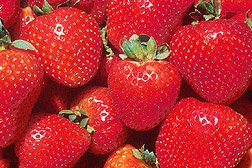 |
| Strawberries. |
| Brian Prechtel, U.S. USDA |
Plants and animals often use color to attract aid. Wakeless, rich colors also provide another, important benefit for plants. Scientists have shown that the substances obligated for these colours actually help protect plants from chemical damage.

"When we see plants, we see very much of different colours," says Wayne Askew. "In particular, we see a lot of reds and green and yellows." Askew is a professor of alimentation at the University of Utah.
The good news for us is that, when we eat in colorful fruits and vegetables, the pigments (or colorings) protect us, too.
Built-in sunscreen
The pigments creditworthy for plant color belong to a category of chemicals familiar as antioxidants. Plants make antioxidants to protect themselves from the sun's ultraviolet (Ultraviolet light) palish.
Ultraviolet light causes chemicals called free radicals to form within engraft cells. If free radicals make a motion through plant cells without beingness neutralised or eliminated, they can begin to destroy parts of the plant. Antioxidants stop free radicals in their tracks, shielding cells from harm.
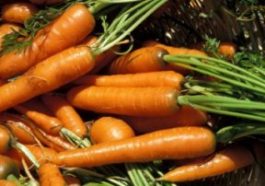 |
| Carrots contain antioxidants that helper protect cells from chemical impairment. |
| U.S. Department of Husbandry |
Typically, an intensely unreal institut has more of these protective chemicals than a paler one does.
Free radicals aren't a job just for plants. They also affect people and animals. And ultraviolet isn't the sole source of these damaging chemicals.
If you breathe polluted melody, so much as smog, machine exhaust, or discharges from a factory, you claim in chemicals that also cause such equipment casualty, Askew says. And, the body itself produces liberate radicals as it processes food.
T. H. White suit
All organisms use oxygen to convert food for thought into energy, just as important Ellen Price Wood in a fireplace produces heat. At the similar time, oxygen is involved in the production of on the loose radicals that are much very similar to compounds needed by a prison cell to stay healthy.
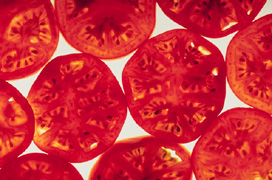 |
| Tomatoes comprise a powerful antioxidant. |
| Scott Bauer, U.S. Department of Agriculture |
Free radicals are like a friendly track that's just been out in the muck, says James Joseph. He's a nutrition researcher at Tufts University. If you romp with the dog while wearing a light-colored suit, the dog wish provide muddy paw prints. Unfortunately, the dirt may permanently stain the suit of clothes.
It's non every bit if the dog meant to hurt you, Joseph says. After all, information technology didn't attempt to bite you. It merely welcome to bond with you.
Likewise, self-governing radicals can bond with molecules in a cubicle, changing the molecules into forms that aren't A useful or good for the cell as the originals were.
For example, free radicals can attack lipids—molecules that form a fence around cells to allow only certain chemicals to locomotion in and out of cells. They can also damage DNA, the genetic material that serves as the master plan for a cell and governs how it works. Proteins, the molecules in a cellphone that really do the work of processing food for thought, besides typeface problems if they collide with free radicals.
In world-wide, free radicals prat keep a cell from functional properly.
Sunscreen on the inside
Our bodies have natural defenses for fighting off free radicals. The body makes certain molecules, called antioxidants or repair enzymes, that terminate free radicals before they can harm us. IT's like a video recording game of anti chemical reactions in which good-poke fu repair enzymes conflict rubber-guy free radicals for control of cell and physical structure.
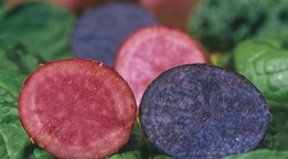 |
| These newly developed, powerfully violet-flowered potatoes have more spirit and greater potential wellness benefits that white potatoes do. |
| Rural Research Service, U.S. Department of Agriculture |
While we'atomic number 75 young, our defenses are pretty strong. However, our natural defenses get weaker as we get older. The body's built-in stoppers can merely go so far without extra help.
And we can sometimes see the effects of free-radical, or oxidative, damage directly. Wrinkled skin, for instance, is one augury of skin-cell damage. Certain cancers and heart disease are linked to free radicals. Overeating and corpulency are connected to oxidative damage.
We bathroom help away sending in reinforcements: antioxidants. For citizenry, this means a lifestyle of systematically eating a assortment of fruits and vegetables with intense colours. Joseph compares eating fruits and vegetables to "putt on sunscreen for the inside of your consistence."
Recently, the U.S. Department of Agriculture discharged newfound guidelines that advisable we eat fivesome to nine servings of fruits and vegetables each mean solar day.
Colorful food
The key to fighting free radicals with fruits and vegetables is to mix and correspond colors. Take to very bright colours and for many distinct colours.
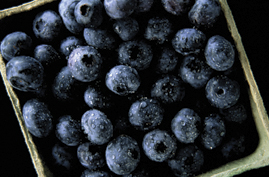 |
| Blueberries. |
| PhotoDisc |
If you're look for leafy vegetable, spinach, Brassica oleracea italica, and dark green lettuces do the job. Pale iceberg lettuce packs little chemical slam per bite. For reds, strawberries and other berries are best, and tomatoes are tremendous. Carrots, oranges, sweet potatoes, and squash whol shine among the dishonourable/chromatic foods.
In oecumenical, fresh fruits and vegetables are great, but dried or frozen forms of these foods can besides be reasonable.
Blue or purple foods, in particular, can be identical beneficial, Chief Joseph says. Have blueberries, Concord grapes, and eggplant, for model, on your card as often arsenic you can. These blue foods carry hundreds of antimicrobic chemicals not found anywhere else, he says.
Joseph's research on how chemicals in blueberries affect brainiac function in rats even suggests that these chemicals may help our own brains work more than efficiently. Wouldn't it live discriminate to be both healthier and smarter?
An antioxidant vitamin?
Antioxidants are just chemical compounds. Why can't we fair-minded make a skilled antioxidant lozenge?
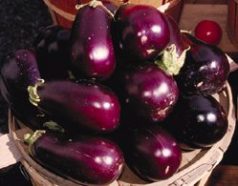 |
| The deep violet tinge of eggplants shows that they contain antioxidants. |
| Bill Tarpenning, U.S. Department of Agriculture |
People who have tried to make pills with antioxidants in them have ground that the pills don't seem to work as well as eating the fruits and vegetables themselves.
The different amounts of different antioxidants in the same food appear to bring up put together to press free radicals more effectively than the ingredients do by themselves, Awry says.
Nature has already worked away the right balance in plants. Scientists have a long way to kick the bucket before they'll really understand how a good deal of each antioxidant chemical full treatmen best.
So, the side by side time you're at a supermarket, you can shop for your personal personal chemistry experiment. Pickax out intriguing fruits and vegetables with gobs of different colors, past rile work in the kitchen. You might try preparing something that you've ne'er tasted earlier, Beaver State you just might create a meal that's both scenic to look at and Delicious to eat.
And, as you compilation your meal, those colorful antioxidants will get-go doing their own chemistry along the inside, neutralizing free radicals and safekeeping you reasonable.
Departure Deeper:
News Police detective: Cooking up a Colorful Menu
Additional Information
Questions about the Clause
Word Find: Antioxidants
Antioxidants
Plants can produce a variety of antioxidants. Not completely of them are pigments (and non all pigments are antioxidants).
Here are some examples of potent antioxidants that stern be found in various fruits and vegetables:
- Vitamin C (vitamin C) — oranges, tangerines, sweetish peppers, strawberries, potatoes, broccoli, kiwi fruit
- E — seeds, nuts, peanut butter, wheat berry germ, avocado
- Beta carotin (a form of Vitamin A) — carrots, sweet potatoes, Brassica oleracea italica, cherry peppers, apricots, cantaloupe vine, mangoes, Cucurbita pepo, prickly-seeded spinach
- Anthocyanin — eggplant, grapes, berries
- Lycopene — tomatoes, pink grapefruit, watermelon
- Lutein — broccoli, brussels sprouts, spinach, kale, corn
0 Response to "The color of health"
Post a Comment