Art Center Wear in Ghana Ghana Wear for Ladies
A muscle-heavy man sits, staring unsmiling at the camera, on a throne of yellowish plastic water cans. His biceps push button out from under the puffed shoulders of a wax-print blouse; two hairy ankles emerge from below a blue patterned skirt; his caput is wrapped in a big piece of cloth, a huge bow hanging over his left ear.
The man is Ghanian artist Serge Attukwei Clottey and the clothes he'due south wearing belonged to his recently deceased mother. The piece, My Female parent's Wardrobe, was inspired by what Clottey saw every bit the basic injustice at the centre of Ghanaian funeral rituals. According to Ghanaian tradition, a mother's belongings are locked away for a yr after her death and then distributed to her daughters and other women in the family.
As an simply son, Clottey had no sister to inherit these belongings and so would have lost the very textile of his mother'southward memory. So he decided instead to put on his female parent'southward blouses, acquit her bags and walk through the streets of Accra.
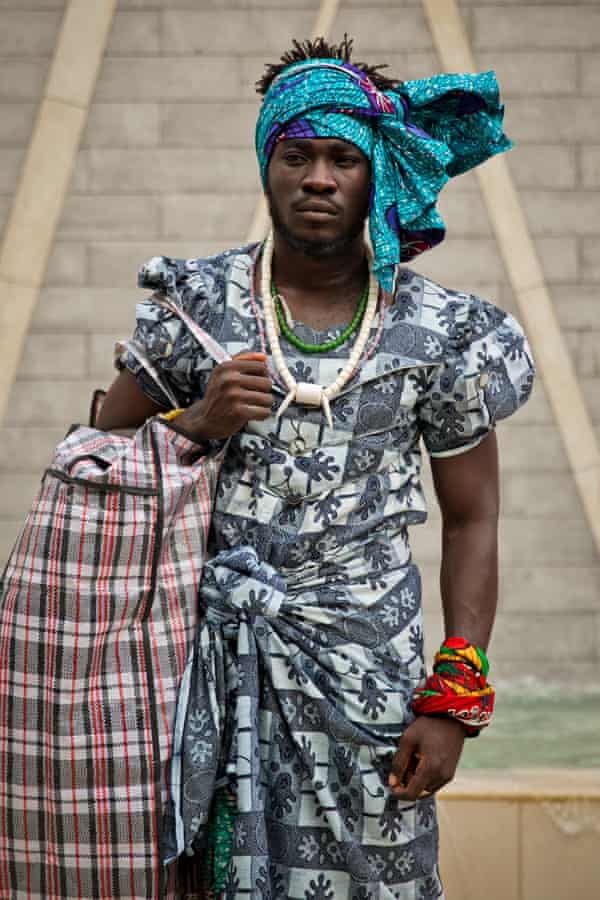
"I wanted to enact my relationship with my mother but likewise point out this imbalance," explains Clottey, speaking to me at the ane:54 Contemporary African art fair in London. "I could feel her presence very close up, they had her olfactory property." The remainder of Clottey's GoLokal Commonage – a group of artists, family and friends based effectually Clottey'due south studio – also joined in, with both men and women leaving their homes, dressed in their mother's wardrobes, to convene in the heart of the city. "Gender roles are very limited in our community merely nosotros all felt very comfortable in those clothes," explains Clottey. "People who saw us were taking pictures and very happy at the idea."
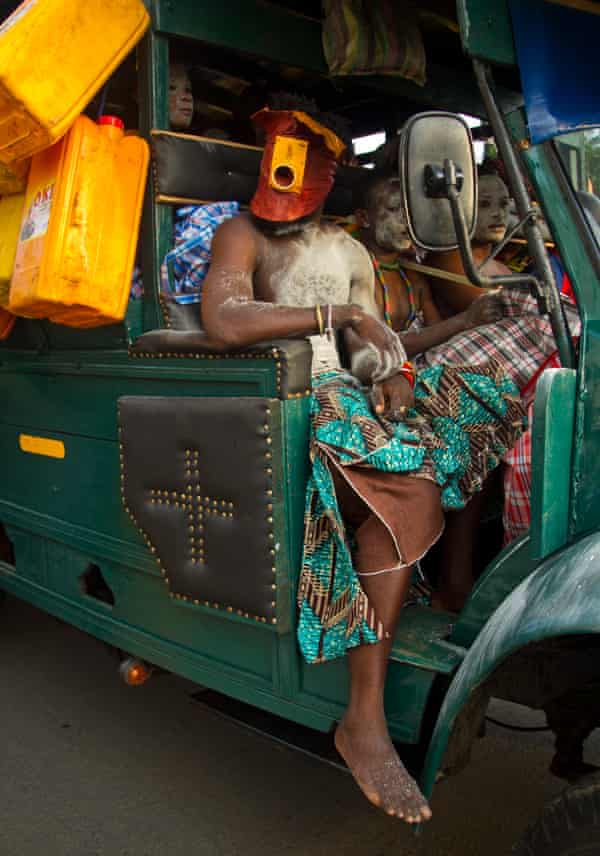
Clottey, who trained in Brazil and whose father is likewise an artist, is perhaps best known for his work with xanthous plastic jerry cans used to collect and acquit water – what he calls "Afrogallonism". Tapestries and sculptures made from these objects are intended to highlight Republic of ghana's water crisis and soaring levels of pollution. But, twinned with his mother's apparel, the cans also said something interesting about female person domesticity, duty and daily life. "My female parent was collecting the plastic gallon cans for me when she was alive," says Clottey. "They are of the streets, they're everywhere, simply they are related to women considering most of the time they're the ones who collect water. Then I similar to bring them into the gallery space – to give them that prestige."
Clottey'southward functioning installations take included The Displaced , shown in video at Feuer/Mesler New York in 2015, in which the GoLokal collective stood on Labadi Beach, with line-fishing nets covering their bodies, enacting the trade and migration story of the Clottey family; and African Electronics in which GoLokal paraded through the streets of the Jamestown district wearing costumes made from suits, cameras, cassette tapes, ceremonial robes, trunk pigment, rope, material and, of course, those yellow jerry cans. "African Electronics isn't about electronic gadgets, simply about the minds behind those inventions, virtually individual power," says Clottey. "In Ghana we utilize animals, plants, nature to heal ourselves, to communicate our spiritual problems and that is very powerful. I grew up in a religious family merely I'thousand at present getting more spiritual past accepting our traditions."
Republic of ghana, like much of the developing world, is a identify where pre-industrial, analogue and digital applied science coexist; where mines, mobile phones, water cans, Instagram, fishing nets and video cassettes weave together in daily life. Clottey uses his ain torso, in performance, to try and bring together these disparate and competing forces.
"I used to work as a model," he says. "To work in the arts you take to discover a way to make money, but I was likewise interested in how modelling tin can manipulate the manner you lot move. When I realised that I could also use that body in my piece of work, I already had an audience who were interested in me as a model."
Clottey says that his performances are at present met with enthusiasm and curiosity in Accra, but it has taken some fourth dimension. "Our costumes are made from elementary materials and we use people'due south energy; so people would attack us because they idea there was something spiritual to what nosotros were doing. People without skill are scared to express themselves; they feel similar they don't have a platform. Simply they desire to experiment with their ideas."
GoLokal'due south next project volition be a mock election, held at the 1957 Gallery in Accra in Dec. "It will exist chosen The Museum of No Tolerance and I'one thousand going to campaign to be president," says Clottey, his voice deep and serious. "Nosotros'll showtime working on it in November. There will be posters all over the city and I'll go from house to house offering food and water to people equally part of the entrada. We want to make people aware and conscious of who they vote for. People treat this country similar a medium that they have no control over but politics is very powerful." Clottey wants to highlight Ghana'south bug with corruption, so the ballot boxes will be made of white porcelain so, as he says, it feels like y'all're dropping your vote into a toilet. It's another example of Clottey using everyday objects to engage people with contemporary politics and personal decisions.
Which brings us back to his mother's wardrobe. What, I wonder, has happened to the clothes he wore for the project? "I still have them," says Clottey. "I oft wear her wearing apparel when I'm working in my studio." The paradigm of this 6ft 1in man, carving up the yellow plastic cans that litter the streets and beaches, wearing his female parent's blouses is both foreign and moving. "Sometimes I wrap the fabric around my waist," he adds, "but to feel her close."
- Gallery 1957 will present Serge Attukwei Clottey's piece of work at the 1:54 Contemporary African art fair, Somerset Firm, London, 6-9 October
Source: https://www.theguardian.com/artanddesign/2016/oct/06/serge-attukwei-clottey-ghana-artist-dead-mothers-clothes
0 Response to "Art Center Wear in Ghana Ghana Wear for Ladies"
Post a Comment