How to Use Scale in a Sentence for Art
How practice we perceive calibration in art? Enormous plastic ice cream, huge balloon dogs, or enlarged photo portraits plastered on buildings effectually the world are some of the examples where scale in art is the ascendant element of the artworks' aesthetics. Scale refers to a size of an object in relation to some other, and is one of the principles of arrangement of structural elements in art and design. Scale in art does not stand for the size of an artwork but is a relational principle which is ordinarily divers through the ratio of an object to a human trunk or another object.[1] Relational aesthetics stands at core of each artwork and human body is oft the corrective confronting which the size of each piece tin can be discussed. As humans put themselves in the center of the visible earth, every bit masters of the living environments, artworks are measured regarding proportion relative to the generalized human calibration. They became defined as large, life-size, miniature, or fifty-fifty enormous. The scale in fine art is thus something that is habitually examined and is often an important gene in defining the meaning and significance of each work, particularly in contemporary art.
The Decisions Behind Scale in Art
Unlike scaling is practical in art when something needs to be emphasized, or when through disproportionate size the importance of the represented is underlined. This does non hateful that we are constantly bombarded with works that take unusual scaling patterns, but that scale in fine art is an essential element that is nowadays and thought out even in works that at first observation do non seem to stand up out regarding this element. Paying attention to and elaborating on scale in art therefore becomes an of import aspect of any artistic evaluation and criticism. Exploring how scale in fine art influences viewing experience through examples, we will see that artists' decisions on the scale of their works are based on the represented motifs, cultural traditions and the message they are trying to convey. Sometimes this message may non surpass the pure aesthetic enjoyment in each slice, but even in these circumstances, calibration is carefully decided on.
Upscaling Pop Art - Claes Oldenburg
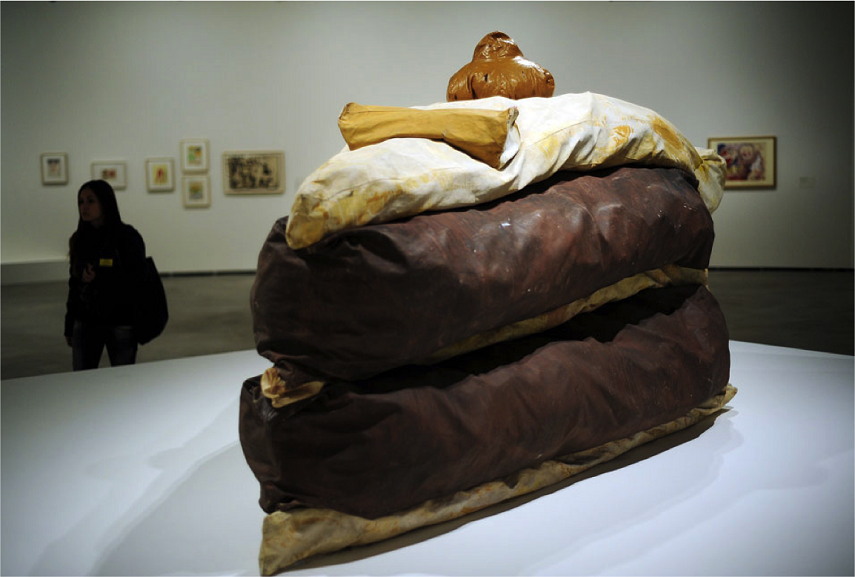
Ane of the leading figures of Pop Art, Claes Oldenburg started experimenting with scale in art in early 1960s, inspired by midtown showrooms on Manhattan displaying grand pianos and luxury cars. His exhibition in 1962 at the Greenish Gallery in New York showcased for the beginning time his soft sculptures created with the help of his then-married woman Patty Mucha, who made his sculptures from fabrics. Pliant fabric of Floor Burger, Floor Cake, and Floor Cone, to mention a few, was a groundbreaking moment in sculptural history transgressing its postulates of firmness and rigidity. The choice of motifs he represented in colossal scales, such as everyday nutrient, brought humor and whimsy in high art and opened up the field of sculpture to subjects from everyday American life. As the artist stated: "my art is made for human being beings, and it's important that people savour the experience of seeing it."[ii]
See more than works by Claes Oldenburg here!
He continued his practice in this field over the years, and moved away from galleries to open spaces where his sculpture reached truly gigantic proportions such as in Dropped Cone or Shuttlecocks. Again playing with calibration in fine art, these works were created in collaboration with his second wife Coosje van Bruggen. By enlarging ordinary objects to enormous proportions, Oldenburg shrinks the viewers, reversing in this mode the traditional human relationship betwixt the viewers and the observed objects. His oversized sculptures also possess a critical edge showing an insight on American civilisation and aiming at its absurdities.
Shahzia Sikander's Awe-inspiring Miniatures and Gigantic Videos
Miniatures are 1 of the art genres where scale is defined by the purpose of the works. Created in different periods and meridians they appeared in votive and religious books, such as illuminated medieval manuscripts, but portraits and paintings were as well occasionally made in miniature. A Pakistani-built-in artist Shahzia Sikander is one amidst the gimmicky creatives who experiments with such artistic traditions and use scale to re-proportion the symbolic meanings such works inherently have. Her involvement, amidst others, lies with Persian miniatures which represented religious or mythological themes. Even though Islam forbids figurative representations, in pocket-size-scale art fabricated for private use such prohibitions were oft ignored.
The Gopi women hairdos that are disembodied and seem to bladder and swirl into a Mughal court are one of her early motifs she used in big-scale video SpiNN (2003) and many miniature paintings before. Fascinated with their aesthetics that "had this wonderful silhouette… that could await like bats or birds" she continued to experiment with them, driven primarily past the involvement in conceptual "distance betwixt the translation and the original…of examining a style, school, genre, and developing a relationship, a language, a dialogue with it." [3] Sikander finds inspiration in the past, which she transforms and translates into gimmicky genres. Scale of the works she references is encumbered with historical meanings and religious postulates. However, in her mixing of history, personal feelings and feel she shifts the perception and challenges the ways we see both her piece of work and the past. Mixing of imagery taken from dissimilar historical references, such equally, for instance, in The Final Post (2010), where a colonial officer of the Due east Republic of india Company appears in a Mughal courtroom, creates a visual hybrid in which polarities between Hindu and Muslim, Due east and W, representation and abstraction seem blurred. The use of small-scale genre in her large-scale videos invites a broader questioning of cultural relationships between the E and the West both in the by and the present.
Scaling Down New York - Miniature Sculptures of Alan Wolfson
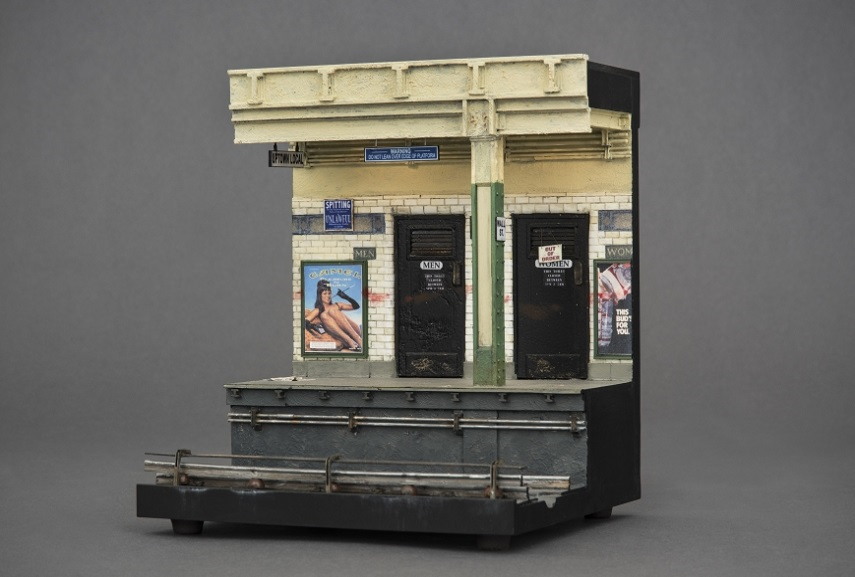
In contrast to Shahzia Sikander's practice, Alan Wolfson takes as a reference i of the largest cities in the world, New York, and transforms its gritty reality into sculptural miniatures. Scaling down the streets, subway entrances, flats and other elements of the urban environment, his primary interest is in the story behind them: "I'm providing you with clues to a narrative, telling a story with minute details... The real affect of my work is non in how small everything is but in the stories these small things tell." [four] His dioramas are free of humans, and resemble a contemporary memento mori made in sculpture, where graffiti, trash, or half-eaten nutrient recalls human being presence that was once there. By experimenting with calibration in art, he as well immortalizes spaces and buildings that are lost to gentrification creating in this mode a monument to a city that does non be anymore. By putting such representations in miniature forms, Wolfson pushes for an intimate observation of urban conditions created by humans.
Scale in Art - Ane of Its Crucial Aspects
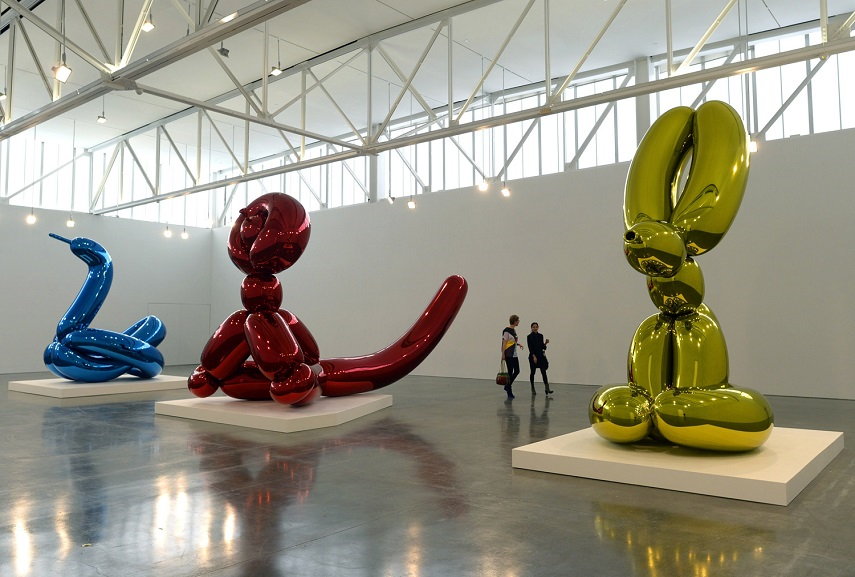
Scale is essential for the viewing feel, not but in fine arts, but likewise in architecture and other visual media. It defines the meaning of work and is one of the aesthetic elements central to its making and reception. Calibration in art questions the part of the viewer and maybe more than other elements directs attending to the relation betwixt a work and location or place. It is one of the crucial aspects of fine art that affects the reception of each piece of work as actual artwork. As seen from examples given above, scale is used as an expressive element that is often filled with historical and cultural meanings. Referencing and re-scaling of different works and objects infuses the reading of art with original interpretations, unencumbered with general theories of world art, and national and geographical distinctions. Among gimmicky artists at that place are many who play with scale, including some of the best known such equally Jeff Koons. Significance of their works partially comes from unusual calibration their works take, which disrupts cultural traditions and viewing practices.
References:
- Lamp L., Design in Art: Scale and Proportion , sophia.org [Nov 26, 2016]
- McKenna K., (1995), Art : When Bigger Is Better : Claes Oldenburg has spent the past 35 years blowing up and redefining everyday objects, all in the name of getting fine art off its pedestal , articles.latimes.com [November 26, 2016]
- Sheets H.K., (2015), Shahzia Sikander: Maximalist Miniatures , artnews.com [Nov 26, 2016]
- Anonymous, (2015), Alan Wolfson'southward Miniature New York Sculptures , www.huffingtonpost.com [November 26, 2016]
Featured images: Shahzia Sikander - Video Even so from Spinn, 2003. Image via angryasiangirlsunited.tumblr.com; Claes Oldenburg - Sculpture in Minneapolis. Image via pintrest.com; Alan Wolfson - Bay Ridge Subway Archway, 2016. Image via hollistaggart.com. All images used for illustrative purposes only.
Source: https://www.widewalls.ch/magazine/scale-in-art
0 Response to "How to Use Scale in a Sentence for Art"
Post a Comment